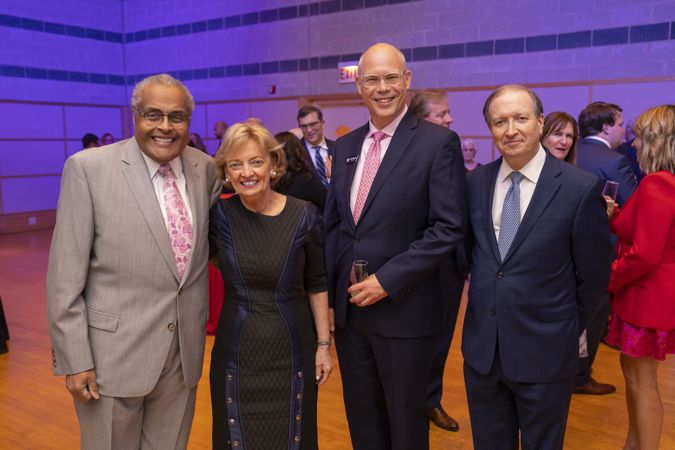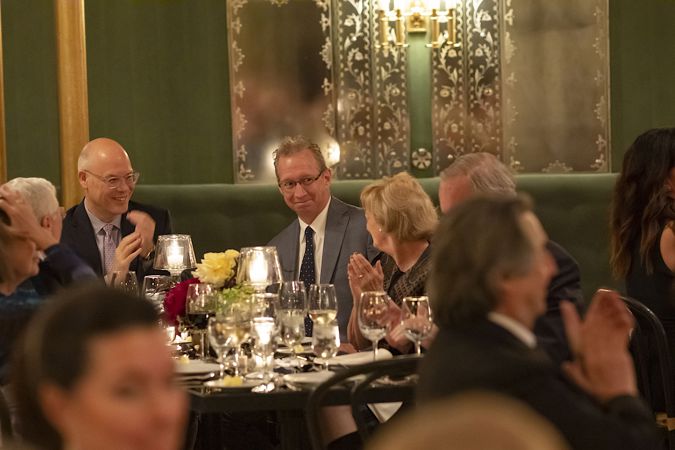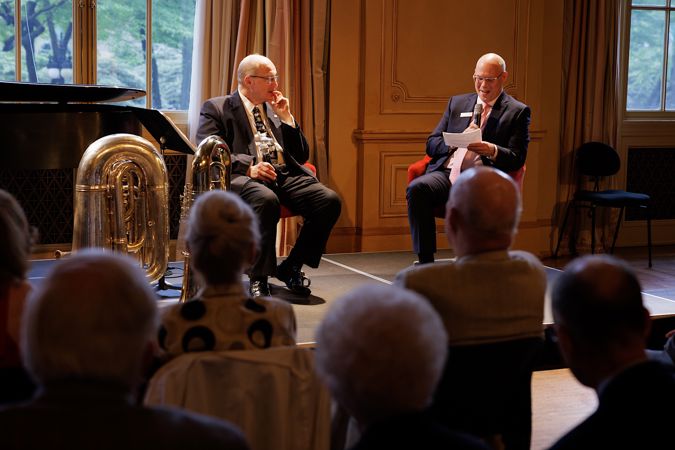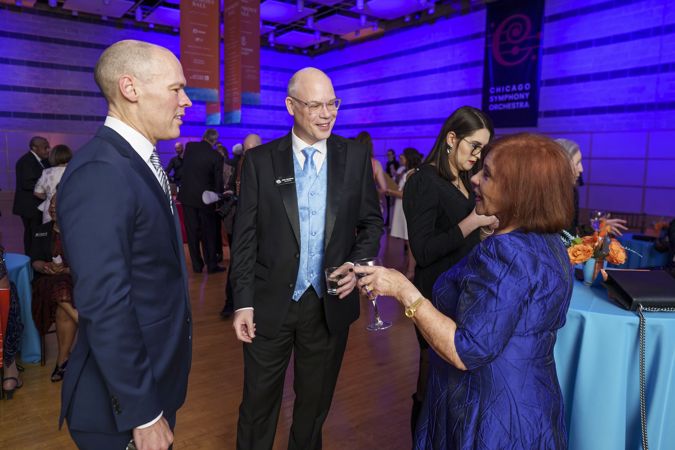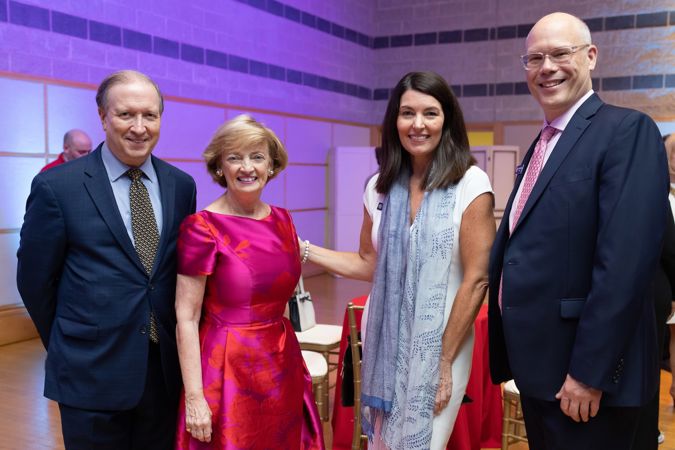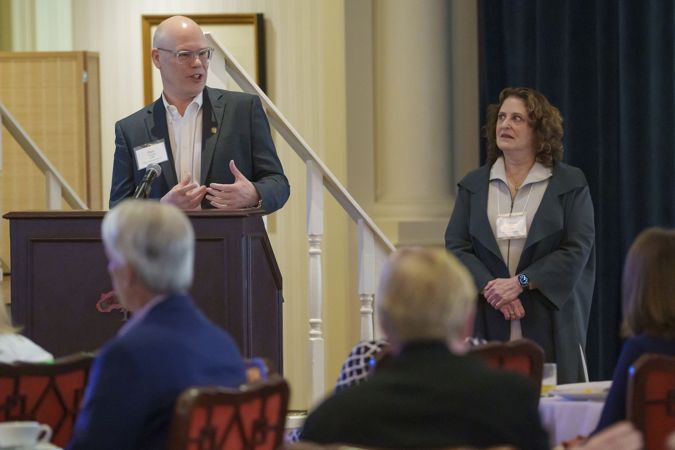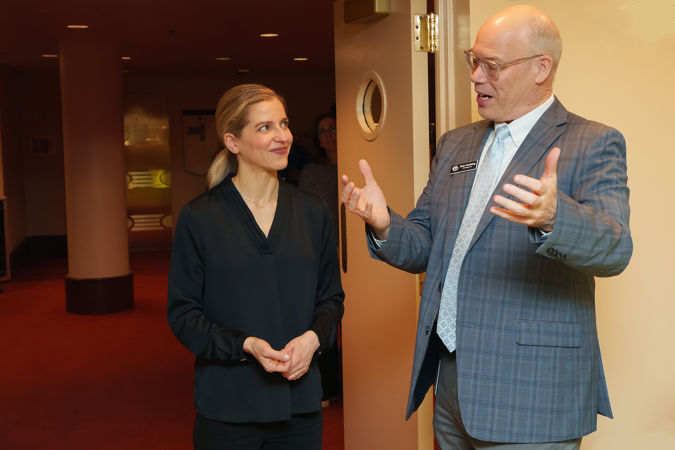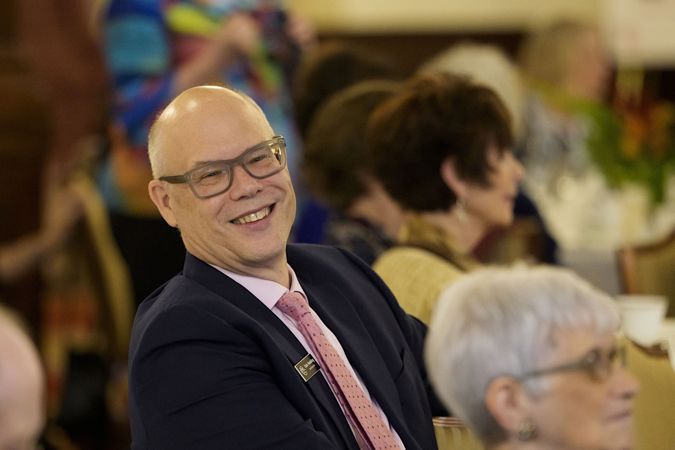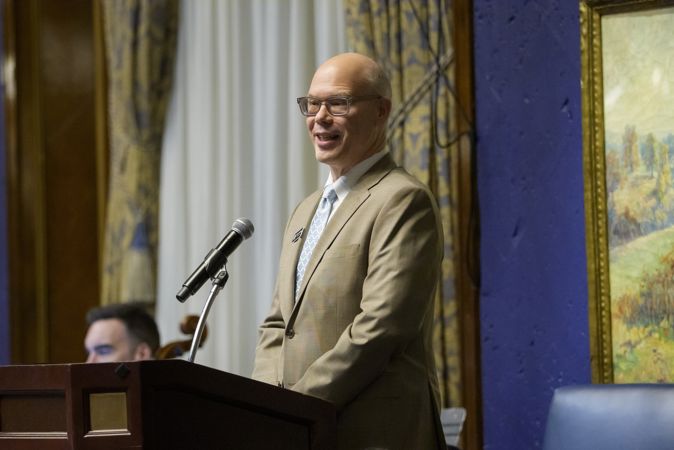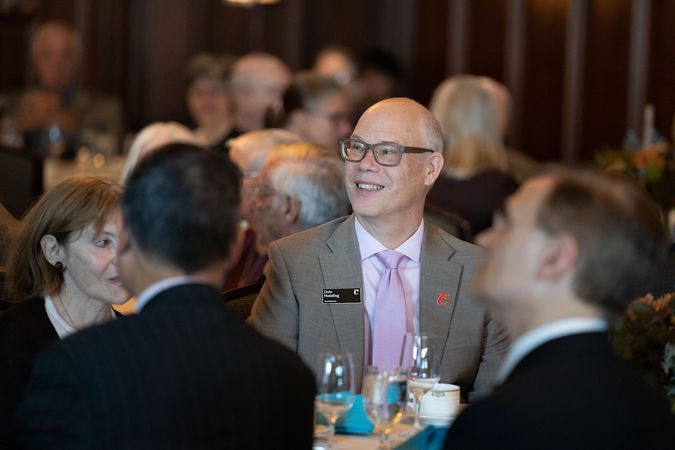

Dale Hedding, vice president of development for Chicago Symphony, started out with plans of being a professional trombonist.
© Todd Rosenberg Photography
Dale Hedding started his career with a plan of becoming a professional trombonist, but when he was in the Air Force Band of New England, he quickly discovered that he was more interested in planning concerts than playing in them.
“I figured out then that I wanted to be the music organizer, and I wanted to be the one who explained to people why it mattered,” he said. “I didn’t know what that was called back then. There weren’t so many clearcut arts-administration programs. You kind of stumbled into it.”
Since 2019, Hedding has served as vice president of development for the Chicago Symphony Orchestra. The post is the culmination of an arts-administration career that has taken him to major music organizations such as the Cleveland Institute of Music and the Baltimore, Atlanta and National Symphony orchestras.
He grew up in Rome, New York. a mill town in nearly the exact center of the state. He tried playing the violin in elementary school, but he didn’t like it. It was only after he attended a concert of the Syracuse Symphony Orchestra that he got excited about music.
Hedding rushed to the band teacher at his junior high school and asked if there were any instruments available that he could play. (His family couldn’t afford to purchase one.) “The teacher told him: ‘Look, I’ve got a trombone, and you look like a tall kid.’ So off I went to become a trombone player,” he said.
Music became such an important part of his life that he got his undergraduate degree in trombone performance at Indiana University’s well-regarded Jacobs School of Music. “I just knew early on for whatever reason that I really loved classical music,” he said. “It wasn’t something that was part of our home, and no one in the family was overly educated or listened to anything like that, but, for whatever reason, I just caught the bug.”
After graduate music studies at Kent State University in Ohio, he joined the Air Force Band of New England and found that he loved all his subsidiary duties like promoting concerts, starting a chamber-music series and working with presenters. He soon realized that supporting musicians was his passion.
He enrolled at the State University of New York-Binghamton (now Binghamton University) in one of the rare master of business administration programs then to offer an emphasis in arts administration. “That really set me on the path,” he said. “I had a lot of performance background and music training, but that got me really excited about getting those business classes and understanding them well and having a natural affinity for it.”
During his final year of graduate studies, Hedding landed an internship at the Kennedy Center in Washington, D.C., where he wound up working for eight years, including the last three as head of development for its then-resident ensemble, the National Symphony Orchestra.
He soon discovered that he had an affinity for fundraising, and that has been his main focus ever since. “I love being the one to tell everyone why music is important, being in the advocate role,” he said. “And it turns out that’s what you do in development.”
Starting in October 2017, he served as vice president of the Arts Consulting Group in Washington, D.C. He thought he was done with orchestras, but when his current job at the CSO came open, he couldn’t resist.
In an interview for Inside the Music, Hedding talked about what drew him to the CSO and what sets apart fundraising for a major international orchestra:
What drew you to the Chicago Symphony Orchestra?
I didn’t grow up here, but this was my orchestra as a kid. When you’re at the Indiana University School of Music and a brass player, the Chicago Symphony Orchestra was it. Our master teachers we took lessons with were from there, and we would pile into our cars at night and drive up here to watch concerts. All my records were the CSO, so it’s really funny that 30-35 years later, this job comes open when I’m out consulting. A good colleague of mine was leading the search for Jeff Alexander [Chicago Symphony president] and just said, ‘I know you don’t want to work for orchestras anymore, but I’m dragging you to Chicago to see the unique things that are going on there.’ And it was true.
What was true?
That there were amazing things going on here. There was a lot of energy here. The orchestra was going in a great direction, lots of exciting things happening.
What’s different about working at the CSO vs. what you have done with past orchestras?
At this level — these Big Seven orchestras — they are almost triple the size of all the other big orchestras, so it’s a really substantial operation. The fundraising levels are huge, of course, but this is what I do best. I’m the strategist in fundraising. That’s always been my strength. And in a place like this, I really get to use that to its fullest potential, because with this size of development teams, you have a lot of specialists.
When you start out in smaller orchestras, you are a jack-of-all-trades, but when you get this big, you have a whole separate foundation-corporate team and a major-gift team. We have people who specialize in data analytics. So, you have a lot of people who are really expert in these areas, so you can really push it harder. It’s also a lot more talent to have to manage. The volume is just staggering here. This is one of the busiest orchestras in the world. With such intensity and volume, staying on top of the planning and the continuous execution of the plans is a key part of creating success and meeting the goals.
What appeals to you about what you do?
I think people who are really good at development at this level tend to accept people where they are. I’ve always had a real natural instinct for people. Everyone likes music for different reasons. Some are altruistic. Some are art-based. Some are more focused on civic pride and social engagement. There are all different reasons people might want to be part of supporting an orchestra. I find people’s lane, what appeals to them and I find a fit for their passion. I think I’m a great listener and I like really hearing why people got involved and what pulled them into it and what their influences were.
I think one of things we have done really well here in the last handful of years is that we have moved a lot of donors around. Historically, the CSO was just so famous on its own as a great classical orchestra. But we also have one of the country’s biggest jazz series here. We have piano and chamber-music series and this huge Negaunee Music Institute arm, so we have started to find that people like a lot more of those things, not ‘instead of’ but ‘and, and, and.’ So, we have some people doing four, five or six gifts in a year to all the things they like. So, finding what makes people feel engaged and happy — I think that is a big part of a success matrix.”
And what are some the challenges? One of the challenges has to be what you were saying earlier about the sheer quantity of money that you have to raise every year.
Back in my early days at the Kennedy Center, I don’t know what the exact percentage was, but fundraising was probably 20 percent of the operating budget of a large organization. It was kind of the icing on the cake, what you used for special projects. And it’s grown and grown first to 30 and then 40 percent. Now, fundraising in these big orchestras, between what we pull out of the endowment, which is still fundraised money, and annual fundraising, it can be 50-60 percent of the operations budget of an organization. That’s a big burden. It’s what our job is, but it’s also why you see fundraising teams grow so large in recent years.
What might people find surprising about your job?
It’s not surprising, but one thing is that when you do development, you control almost none of your own assets. To do your job, you have to work with artistic to let them let you have access to the artists to meet donors. You have work with marketing, because they produce all of the brochures and posters that we need donor credits on. We have to work with all the facilities people to make sure we can have activities and receptions for donors. So, a lot of my job and my team’s job is that you’re just working closely with every department within the organization, because to do our job well, we need a little bit of every other department.
Is there something different about fundraising for a symphony orchestra vs., say, a school, hospital or pet shelter?
With cultural organizations, music organizations, you’re really trying to create immersive experiences. Every cause is important, but so is feeding the soul with music. What’s different here is that we really try to connect people with the organization, and we like when they know the musicians who see over many years. We like them to learn more about the CSO and what it does. I think it is a living, breathing thing and our best work is when donors can touch and feel it – meet a musician they’ve been looking at for 20 years onstage, but never knew.
There is so much in the news about the fundraising difficulties that major arts organizations are facing, especially since the pandemic.
One of the big challenges is that you need the current money and the long-term money. That’s why endowments are so important. We are in the tail-end of our SEMPRE ALWAYS campaign. The goal was that it was going to be a $175 million campaign [for long-term financial stability]. We’ve raised more than $228 million to date. But, again, I think the critical part of success is that you have to do it all well. You see so many places that want to give up on what we call broad-based giving – small donors, membership programs. Everyone thinks direct mail is dead. It is not at all. People think telemarketing is dead. It is not. You just have to do them well. Success comes from the doing the whole buffet all of these things well.
The head of a smaller symphony orchestra once told me one time that also what you have to do is just ask. He was new and he found that a lot of patrons he was meeting had never been asked to contribute.
I lecture at conferences often and one my messages is that you cannot just ask people once or twice anymore. You have to accept that it might take five to seven touchpoints these days for anyone to respond, so if you’re not asking often through various means — direct mail, calls or events — you’re already behind the game. This is a big mantra up here — our job is not simply asking for money. We have to organize prospects, we have to organize what we are doing, but we have to make sure we are making the case as to why they should care and support the CSO, but we still have to ask them a lot. I think places don’t ask nearly enough. Fundraising is about asking and reaching people.
Could you say how fundraising is going for the CSO?
We just had one of our better fundraising years in several years and between the campaign and the annual fundraising, it is going very well. We’re probably in solid shape, compared to many other large cultural organizations, but it does not get easier. Our business model is all about live artists and live performances, so costs will continue to rise, and our job is to continue to meet those needs. I think we’re doing a good job at the CSO, but there will never be a time to settle into cruise-control mode. The excitement of our work is to always be moving forward and to find new and exciting ways to engage more donors in the greatness of the CSO.
What gives you hope in this ever-changing world of philanthropy and what worries you?
We are in such a social-media and online world that people really crave live experiences, and that is exactly what orchestras provide. And we offer a whole range of things from classical to jazz to movies with live orchestra to pop music. So, that’s got me really hopeful. We are also a really philanthropic country. If you make your case and give people a reason to give or support, they will. But people want to know what the impact of their giving is. That’s something that has shifted a lot in recent decades, so you have to tell them. I’m optimistic about all that.
What keeps me up at night? There are just so many competing causes. In a 20-year window, the number of non-profits has doubled in the United States – that are just so many things pulling at everyone’s heart- and purse-strings. This represents so many people and organizations doing good work, but it also means we’re all fighting for the same donors and dollars.