Johannes Brahms, circa 1865, about the time that he composed his German Requiem: He regarded the work as a consolation for the living, rather than the traditional lament for the dead.
For Donald Palumbo, Johannes Brahms’ A German Requiem holds a special place in his heart. From his first concert with the Rochester Oratorio Society as a teenager to Carnegie Hall with the Metropolitan Opera Chorus in 2023, Brahms’ choral masterpiece has been a touchstone for Palumbo throughout his career.
Now entering his second season as director of the Chicago Symphony Chorus, Palumbo sees the upcoming performances of Brahms’ A German Requiem on Oct. 29-31 (with soprano Louise Alder and baritone Konstantin Krimmel) as an opportunity to hone the Chorus’ sound. The work has formed an integral part of the Chorus’ history, as it has for Palumbo, with CSO recordings of A German Requiem from 1978 and 1983 winning Grammy Awards for best choral performance.
Palumbo spoke about the Brahms between preparatory rehearsals for William Walton’s Belshazzar’s Feast — a work that the CSO has not performed for 50 years and is new to most of the singers. Whereas rehearsals for the Walton have required a lot of note-learning, the familiarity of the Brahms will allow Palumbo to work on what he considers the most important aspect of his job: “establishing a specific tone quality, a sound quality, a way of singing, a way of expressing ourselves that is a lot easier to do when you’re working with a piece that you know well.”
Despite the familiarity of the Brahms, he’s ready to plumb its depths. “It’s one of those pieces, if you have a good chorus, the potential is limitless,” he said. “There are just so many colors to get out of the piece and such a wealth of expression in the phrasing.”
 Rehearsing a piece that is so ingrained does pose its own challenges, however. “We’ll also be confronted with old habits, let’s say, and maybe some sloppy mistakes that have crept in,” he said.
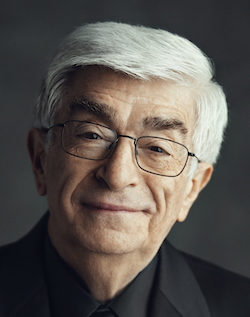
Consequently, he is excited to have ample rehearsal time to work on the piece in depth and establish and refine the sound of the Chicago Symphony Chorus — something that Palumbo (at left) believes is crucial as the organization prepares for a new era of music directorship.
“I think he is going to be an incredible injection of new life and new spirit into not just the Orchestra, but into the Chorus as well,” Palumbo said of Zell Music Director Designate Klaus Mäkelä, who officially begins his tenure next season.
At this point in his career, Palumbo did not expect to be a part of an organization undergoing such an exciting period of change. He could have easily rested on his laurels after stepping down as director of the Metropolitan Opera Chorus in 2024, a post he held for 17 years following a 16-year stint at Lyric Opera of Chicago. “I really did not think there was another new adventure,” he said.
“But look, I think musicians thrive on this kind of thing,” he said. Working on unfamiliar repertoire such as Belshazzar’s Feast or with new collaborators such as Nikolaj Szeps-Znaider, who will conduct the upcoming run of Brahms’ Requiem, is what keeps him going. “There are reasons why conductors keep working long past retirement age. … I couldn’t be happier, I have to say.”
After devoting the last four decades to opera, Palumbo is excited to return to the concert and oratorio repertoire that marked his early career. Brahms’ Requiem was a particularly formative piece. He recalled being “blown away” when he first sang it with the Rochester Oratorio Society as a teenager. He immediately bought a recording and began studying the score. A few years later, while living in Vienna in his early 20s, he had the opportunity to sing it with the Vienna Singverein under Herbert von Karajan.
He prepared Brahms’ Requiem for the first time in the early 1980s as music director of Boston’s Chorus pro Musica. “I remember it as being one of the best things that the chorus had ever sung,” he said of their performance with the Boston Philharmonic under Benjamin Zander.
Concert repertoire eventually took a back seat to opera. Still, throughout his tenure at the Metropolitan Opera, he hoped to take the chorus to Carnegie Hall, but the expense was always prohibitive and the Met’s schedule too intense. Talks resumed when Yannick Nézet-Séguin became the Met’s music director in 2018. A concert at Carnegie Hall finally became a reality in June 2023 with a performance of Brahms’ Requiem.
“I think that was one of the most thrilling experiences of my Met career to finally get to Carnegie Hall with the chorus I had been working with for 17 years,” he said.
For Palumbo, the text is part of what makes Brahms’ Requiem so special and resonates with so many. Unlike traditional Requiems, such as those by Mozart or Verdi, which set the liturgical Latin text from the Requiem Mass, Brahms intentionally chose Bible passages for his German Requiem that do not mention Christ or redemption after death. Instead, the texts focus on the transience of life and the human need for consolation, lending the piece more of a universal sentiment than an explicitly religious one.
“They’re actually words that relate to us as human beings way more than the Latin text does,” Palumbo said. “And it has always struck a chord with me.”


